Why most creators lose leads they've already earned
Your content is working. Your follow-through isn't.
That's the uncomfortable truth behind most TikTok lead gen problems. The video gets views. The comments come in. Then nothing. Not because the audience wasn't interested. Because there was no mechanism to catch them.
The comment is the conversion moment — not the video
The video earns attention. The comment is something more valuable: a declaration of intent.
When someone types "how much?" or "link?" or "can I join?" in your comments, they're not browsing anymore. They've self-selected. They've raised their hand. That's the conversion moment — and it lasts about 30 seconds before the For You feed serves them something else.
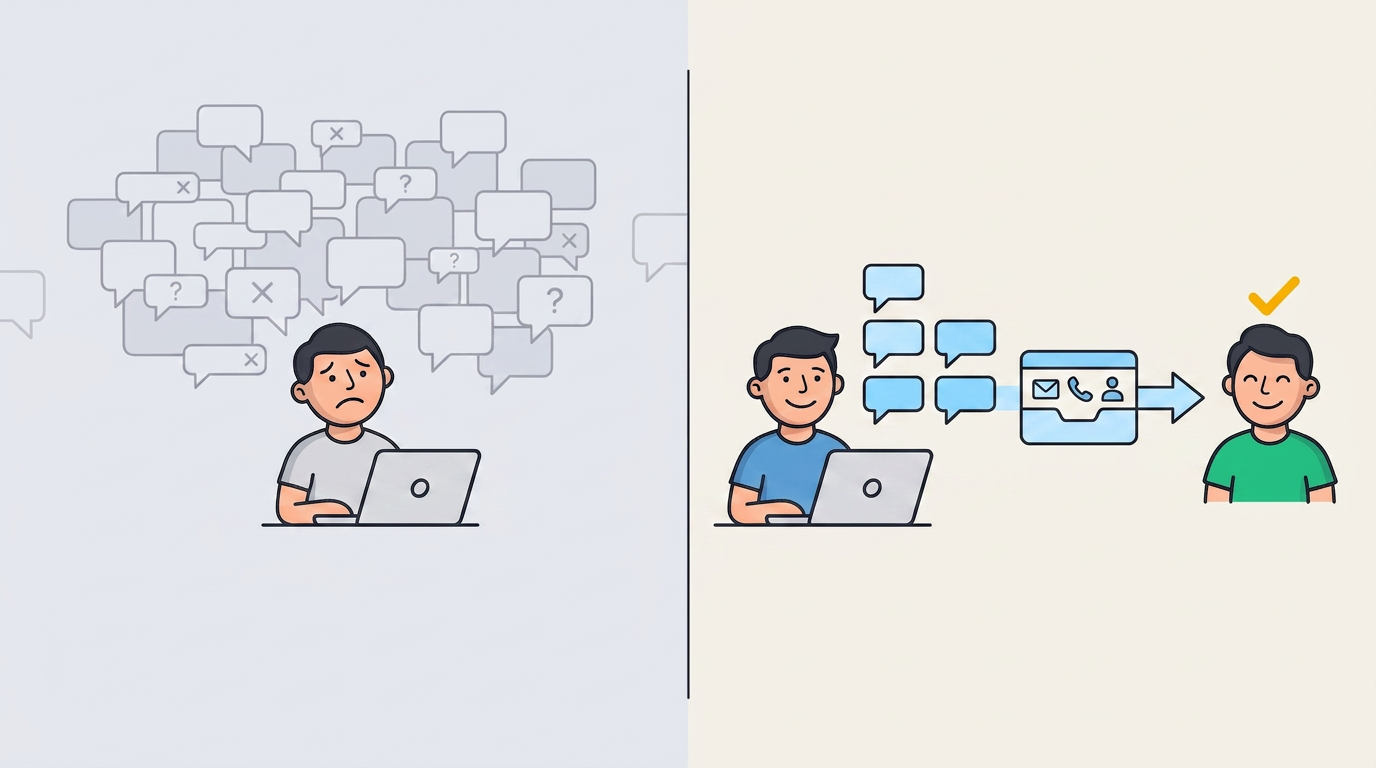
Here's what that gap looks like in practice. An Indonesian fitness coach posts a workout tip video. It lands well — 200 comments by the next morning, dozens of them asking "join?" or "info?" She replies to 12 manually between clients. By the time she gets to the rest, it's been two hours. Those 188 people have watched another 40 videos, followed three other accounts, and completely forgotten they ever commented. Not because her content failed. Because her follow-through did.
The math doesn't flatter manual replies. Even a 20-minute response time — fast, by any reasonable standard — is too slow for the For You feed's attention cycle.
This is where most creator funnels break. Think of it as a four-step loop: Content → Comments → Conversations → Customers. The first step works — creators are generally good at making content. The last two steps can work, once a conversation starts. The gap is in the middle. Comments pile up. The loop never closes.
Why digital creators feel this gap harder than product sellers
A physical product seller on TikTok Shop has a partial safety net: the product tag. A viewer can watch a video, tap the tag, and buy — no conversation required. The DM is helpful but not essential.
Digital and service creators have no equivalent. A fitness coach running an online training program has no product tag to tap. Neither does a marketing consultant selling a strategy session, or an educator running a paid cohort. For them, the DM conversation isn't a nice-to-have — it's the entire funnel. Comment → DM → enrollment link → sale. Remove the DM step, and there is no funnel.
So when a digital creator loses 188 comments overnight, they're not losing potential purchases that might have happened through another channel. They're losing the only channel they have.
The fix is the same for both groups, but the stakes are higher if your offer lives entirely in the DM: you need something that catches every raised hand the moment it goes up — automatically, before they scroll away. That's what the rest of this guide covers.
What "Lead Generation on TikTok" Actually Means for Creators
Most guides on TikTok lead generation are really guides on TikTok advertising. They walk you through Ads Manager, explain the Lead Generation objective, show you what an Instant Form looks like. Useful — but it's one track, and it assumes you have a budget.
There are two distinct tracks. Getting them confused is expensive.
Track 1: Paid lead gen. TikTok's Lead Generation ad objective lets you run ads with Instant Forms — a pre-populated form viewers fill out without leaving the app. Fast, frictionless, and backed by real numbers: TikTok users are 1.3x more likely to sign up for something within an ad on TikTok than on other platforms, and 2 in 5 TikTok users started following a brand after submitting a form. (Source: TikTok Marketing Science studies) It works. It also requires Ads Manager access, a budget, and a tested offer before it's worth the spend.
Track 2: Organic lead gen. Content-driven. Comment-to-DM automation. Bio link strategy. DM outreach. No ad spend — but it requires a system. This is the track almost every ranking guide ignores, and it's the primary path for most creators and small merchants in SEA who aren't running paid campaigns.
Neither track cancels the other. Paid amplifies what's already working organically. But if you start with paid and have no organic follow-through system, you're buying leads and losing them anyway. The organic system comes first.
Paid lead gen: TikTok Instant Forms and the Lead Generation ad objective
The mechanics are straightforward. You create a campaign in TikTok Ads Manager, select the Lead Generation objective, and attach an Instant Form to your ad. Someone taps the CTA; a pre-filled form opens inside TikTok — name, phone number, email, whatever fields you configure. They submit. You get the lead data. They never leave the app.
The format works well for offers that need a commitment step: a free consultation booking, a course waitlist, a product sample request. Friction is low enough that half-interested buyers will still fill it in.
The constraint: it's an ad buy. Lead gen for digital and service creators: courses, coaching, bookings covers when it makes sense to add this layer. Short answer: build your organic system first, prove your messaging converts, then pour paid fuel on it.
Organic lead gen: the comment-to-DM channel most guides ignore
Organic TikTok lead gen doesn't mean posting and hoping. It means building a mechanism that captures intent the moment it appears — which, as covered in the previous section, is the comment.
The channel most guides skip: comment-to-DM automation. A viewer comments a keyword (link?, enroll?, price?). An automated flow publicly replies and simultaneously DMs them — with a product link, a booking page, a course info pack, whatever the next step is. Instant. 24/7. No manual effort.
That's the organic system. Content generates the intent signal; the comment-to-DM layer captures it before the viewer scrolls to the next video. Content that generates leads: the mechanics of intent-signal videos goes deep on building it. The point here: this channel exists, it runs without ad spend, and it's the mechanism most lead gen guides don't mention.
What counts as a "lead" in creator-land
The definition matters. In a traditional B2B context, a lead is an email address in a CRM. On TikTok, for creators and small merchants, that's rarely what it looks like.
A lead is any signal of genuine interest you can follow up on. Broader definition — and the right one.
Two examples. A Vietnamese online English tutor's lead is someone who comments enroll? on her pronunciation tips video, gets an automated DM with a free trial class link, and books a slot that afternoon. No form, no email capture — a comment that became a conversation that became a customer. Similarly, a Thai skincare seller's lead is a customer who DMs asking which foundation shade matches her skin tone and ends the conversation three products into a TikTok Shop order.
Leads in creator-land are: a DM conversation started, a link clicked through, a discovery call booked, a course enquiry in the inbox, a phone number shared for COD delivery. Sometimes it's an email address. Often it isn't.
This matters for how you measure your system. Count only email signups and you're undercounting by a lot. Count every contact who moved from a comment into a conversation — that's your real lead volume.
Account setup: the foundation before you build any lead gen system
None of the organic lead gen mechanics covered later in this guide will work without the right account foundation. This section is short because the setup is simple — but skipping it wastes everything that comes after.
Personal vs Business Account — why it matters for lead gen
You need a TikTok Business Account. Not a personal one.
A Business Account gives you a clickable profile link, a category label, a contact button, and access to TikTok Ads Manager. More importantly for what this guide covers: it's the prerequisite for the official TikTok Business Messaging API — and therefore for comment-to-DM automation.
One clarification worth making: the Business Messaging API is available in many countries. The comment-to-DM capability — comment-triggered auto-DMs — is currently limited to Thailand, Vietnam, and Indonesia. If you're a creator or merchant in one of those markets, a Business Account registered there is what you need. Outside those three markets, comment-to-DM isn't available via the official API yet.
Switching from personal to Business is free and takes two minutes inside TikTok settings. The only real trade-off: Business Accounts lose access to the full commercial music library. If your content relies heavily on trending audio, factor that in. For most creators using TikTok for lead gen, it's not a meaningful constraint.
Optimise your profile as a landing page
Your profile isn't just branding. For anyone who watches your video and taps through to learn more, it's the next step in the funnel — and most profiles waste it.
The formula is simple: who you help, what you offer, one action to take. Three lines, max.
Two bios for the same skincare creator:
Before: "Sharing skincare tips ✨"
After: "Skincare for oily skin in hot climates | Comment SKIN? for my routine guide"
The second version tells a visitor exactly who this account is for, what they'll get, and what to do next. It also plants the keyword — someone who finds the profile directly rather than through a specific video now knows what to comment.
Beyond the bio text: pin two or three videos that explain your offer clearly. Not your most viral video — your most useful one. The video that answers "what do you actually do and why should I care?" converts profile visitors into enquiries. A Jakarta-based business consultant who pins her best "how I help SMEs" video and adds a booking link turns passive profile views into booked discovery calls while she's in client sessions. Her profile does the work; she shows up to the inbox.
That's the goal: a profile that converts without your attention.
The link in bio: where to send people and why one destination beats five
You get one link. Use it like one link, not five crammed through a Linktree.
Multiple destinations split attention. A viewer taps your bio link, sees eight options — podcast, YouTube, Instagram, email list, online store, Shopee, two courses — and picks nothing. The paradox of choice is real, and on mobile it's worse.
Pick the destination that matches your current primary offer:
- Course or coaching: a landing page or booking link (Calendly, a simple sales page, whatever you use)
- Physical products: your TikTok Shop storefront, or Shopee/Lazada if that's where you close sales
- Community or membership: the signup or waitlist page
The bio link handles traffic from people who tapped through from a video but didn't comment a keyword. Comment-to-DM — covered in the next section — handles the higher-intent visitors, the ones who raised their hand in the comments. The bio link catches everyone else.
One destination. One next step. Profile done.
Content that generates leads: the mechanics of intent-signal videos
Most videos get views. Fewer get comments. Fewer still get the right kind of comment — the one that signals "I want this, tell me more." The difference isn't luck or niche. It's how the video is built.
Lead-gen content has a specific job: produce a comment with enough intent that the follow-through conversation can close a sale. That means building the video around a response, not just a view.
The partial reveal: the organic lead-gen format that actually works
Three video formats consistently produce high-intent comments. Each works differently, but they share the same structure: earn trust, then earn the comment.
1. Problem-solution hooks. Open with a problem your audience is already feeling. Solve it — but solve only part of it. "If your Instagram ads aren't converting, it's usually one of three things. The first two are easy fixes. The third is what most people miss — and it's the one I walk through in my free workshop."
The viewer watches because you named their problem. They comment because you've shown you know the answer and they don't have it yet.
2. Partial reveals. The highest-converting format for digital and service creators. Give genuine value — a tip, a framework, a result — then stop one step short. "I just helped a client triple her email sign-up rate by changing one thing on her landing page. Comment CHECKLIST? and I'll DM you the full 7-point audit I used."
The value earns trust. The withheld piece earns the comment. The lead magnet — the checklist, the template, the guide — is why someone types that keyword instead of scrolling on.
3. Social proof stories. Document a client result or your own transformation, enough that the viewer believes the outcome is real. Then gate the how. "My client went from 80 leads a month to 340 in six weeks — comment CASE? and I'll send you the breakdown." The proof persuades; the keyword captures.
Here's what this looks like in practice. A Ho Chi Minh City-based marketing coach posts a 45-second video: "3 reasons your Instagram ads aren't converting." She walks through two reasons on camera. The third, she says, is the one that changes everything — covered in a free live audit workshop. Last line: "Comment AUDIT? and I'll DM you the link." Over the next 48 hours, 400 people comment "AUDIT?". Each gets an instant DM with the workshop registration link. That's 400 warm leads from a single video — people who self-selected by commenting, not a broad ad audience.
Contrast that with the same video ending on "comment for more info." No keyword. No specific offer. Replies have to be manual. Realistically, maybe 20 people get followed up with before the creator's day gets busy. The other 380 are gone.
Same format. Entirely different follow-through.
Writing comment CTAs that get responses
Two placements matter. Miss either one, and you leave intent on the table.
In the video itself: the CTA goes in the last 3 seconds, spoken clearly. Not buried mid-video, not implied. "Comment AUDIT? below — I'll DM you the link." Specific verb, specific keyword, specific payoff.
In the caption: repeat it. Many viewers skim captions after watching. "Drop AUDIT? in the comments and I'll send you the free workshop link" does the job. It also catches people who watched on mute.
The CTA should match the offer exactly. Generic CTAs underperform because they make the viewer do extra work — they have to imagine what they'll get. Specific CTAs remove that friction:
- "Comment TEMPLATE? and I'll DM you the spreadsheet" beats "comment for my free resource"
- "Comment CONSULT? to book a free 20-minute call" beats "DM me for more info"
- "Comment ENROLL? for my July cohort dates" beats "comment to find out more about my course"
For digital and service creators especially, specificity signals that there's a real thing on the other side of the comment — not just a follow-up chat. That's what turns a passive viewer into someone who actually types a word into the comments.
Why question-form keywords outperform bare words
Small detail, real effect. The keyword a viewer comments isn't just a trigger for your automation — it's a signal of intent. The form of that keyword changes how it performs.
"HARGA" (bare word, command-like) performs worse than "price?" (question-form). The question mark isn't just punctuation — it signals that the person is genuinely asking, not testing or messing around. They're mid-decision. That's the moment you want to catch.
Use question-form keywords in your CTAs: price?, link?, info?, enroll?, book?, join?, guide?, template?. Match the keyword to what the viewer is actually asking for.
Bare words feel like a secret code the viewer has to remember and type without context. Question-form keywords mirror what someone would naturally type when they want to know something. They match the intent state — which is why they trigger more reliably and pull comments from people in a buying mindset, not just the curious ones.
Build the keyword into your verbal CTA so it sounds natural: "If you want the workshop link, just comment AUDIT? below" flows better than "type the word AUDIT to receive the resource." The easier it sounds, the more people do it.
Comment-to-DM: How the Automation Actually Works
You've built the content, you've written the CTA, and comments are coming in. Here's what happens next — mechanically, step by step — and why the technical path you choose determines whether any of it is safe to run at scale.
What happens step by step when someone comments a keyword
The sequence is simple. A viewer watches your video, sees your CTA, and types schedule? in the comments. The moment that comment is detected, two things happen simultaneously:
- A public reply posts on the comment — something like "Sent you a DM!" — so the thread looks active and other viewers see it.
- A DM arrives in that viewer's TikTok inbox, instantly, with whatever you've pre-built: a booking link, a program overview, a price list, a download link.
Both happen before they've scrolled to the next video. No manual work on your end.
Here's what that looks like in practice. A Chiang Mai yoga instructor runs comment-to-DM on her morning flow video with the keyword schedule?. Over a weekend when she's fully occupied teaching classes, 60 people comment that keyword. All 60 get her booking link the moment they comment — not when she checks her phone Sunday evening. She opens her inbox Monday morning to 18 confirmed bookings. Zero messages sent manually.
The flow can also branch. Set a 24-hour wait after the initial DM: if no reply, a follow-up sends automatically. Something like:
Initial DM: "Hi! Here are my available slots this week: [LINK]. Reply here to confirm." Follow-up at 24h (no reply): "Still interested? I have 2 spots left this week."
Build it once. It runs on every video you apply it to, on every comment that matches the keyword, around the clock.
The official API vs grey-area bots — why the difference matters for your account
Most automation tools that claim to work with TikTok aren't built on TikTok's official infrastructure. They control your account through fake browsers or scripted sessions — essentially impersonating a human user. TikTok's system flags this. Accounts get restricted or banned. The automation you built to save time ends up costing you the account.
The alternative is the official TikTok Business Messaging API — a channel TikTok has opened specifically for business messaging. Comment-to-DM, automated replies, DM sequences: all explicitly permitted. TikTok knows the messages are being sent; that's the point.
One distinction worth being precise about: the Business Messaging API itself is available across many markets. It's specifically the comment-to-DM capability — comment-triggered auto-DMs — that is currently limited to Thailand, Vietnam, and Indonesia. If you're operating in one of those three markets, this channel is open to you. If you're not, the API still has other uses, but the comment trigger doesn't apply yet. (See the TikTok comment-to-DM docs for current availability.)
The practical implication: grey-area bots can send a DM. They can't do it within a sanctioned framework — which means they also can't access the post-window follow-up messages the API allows. The next section covers the messaging window in detail, but the short version is this: official API access isn't just the safer option. It's what makes the full follow-up sequence possible at all.
Setting up your first comment-to-DM flow: keyword, public reply, DM message
The setup is no-code. The logic is: keyword trigger → auto-public reply → auto-DM → optional follow-up conditions. Each step is a block you configure, not code you write.
A few decisions to make when you build the flow:
Choose the keyword carefully. As covered in the content section earlier, question-form keywords — price?, link?, enroll?, book? — outperform bare single words. They match how a real buyer naturally types. Too generic (just info) and you'll catch accidental matches. Too obscure and people won't use it.
Write the public reply to confirm action. Viewers who commented want to know something happened. "Check your DMs!" or "Sent you a message!" does the job — and signals to anyone scrolling the comments that there's a real response system running, which nudges others to comment too.
Make the DM specific to the offer. The first DM isn't a greeting — it's the payoff. If someone commented enroll? on your course video, they want the cohort dates and the signup link. Send that. The DM that arrives immediately needs to deliver exactly what the CTA promised, or the trust you earned with the video evaporates.
If you'd rather not build from scratch, there are 14 ready-made templates across five use cases — Grow Followers, Engage Audience, Drive Sales, Collect Leads, Customer Support — that give you a working flow structure you can adapt in a few minutes.
Connecting a TikTok Business Account, picking a template or building a flow, and publishing takes under five minutes. What it then does for you runs indefinitely.
The messaging window: what it is, what you can do with it, and what the rules actually say
Most creators discover the TikTok messaging window at the wrong moment — after a conversation goes cold and they can't figure out why. Understanding it before you build your DM sequence changes how you design the whole flow.
The 48-hour window explained plainly
When a user messages you (including the message triggered by their comment), a 48-hour window opens. Inside that window, you can exchange messages freely — send links, ask questions, follow up, close the sale. The clock resets every time they reply. An active conversation stays open as long as they keep responding.
The strategic implication is simple: the sooner you trigger the conversation after the comment, the more of that window you have to work with. A comment at 11pm is a window that opened at 11pm. If your first DM doesn't arrive until you wake up at 8am, you've already burned nine hours of your most valuable follow-up time. This is exactly why the instant-trigger mechanic covered in the previous section matters — the comment-to-DM trigger is the window-opener, and it fires in under a second.
Post-window: you still have 3 messages — use them
Here's what most guides get wrong: they treat the 48-hour window as a hard cutoff. It isn't.
After the window closes, TikTok's Business Messaging API still allows you to send up to 3 additional messages to that contact. (Source: TikTok Business Messaging API messaging limits.) That's a restock alert, a "spots still open" nudge, a final follow-up on an unanswered enquiry — sent to someone who raised their hand and went quiet.
This matters more than it sounds. A buyer who comments "price?" at 11pm on a Tuesday, gets your DM, and doesn't reply until Thursday afternoon hasn't lost interest — they got busy. Your post-window message lands right when they're back. That's not spam; that's a well-timed follow-up on a conversation they started.
One hard condition: this is an official-API-only capability. Grey-area bots operate outside TikTok's sanctioned mechanisms — they can't access post-window follow-up in any compliant way. The official API isn't just the safe path; it's the only path that makes this possible at all.
How to design your DM sequence around the window
The window should shape how you order your messages, not just how many you send. Here's how it plays out in practice.
A handmade jewelry seller in Hanoi posts a short video of her latest earring collection. She sets a keyword trigger on "price?" and builds a three-message sequence:
- Instant (comment triggers it): "Hi! Here's the full price list for this collection: [LINK]. Only 3 sets of the gold hoops left — let me know if you want one held."
- Hour 20 (if no reply): A second DM sends automatically — a single product photo with: "These are the ones people keep asking about. Still have 3 sets if you want to grab one before the weekend."
- Hour 44 (if still no reply, final in-window message): "Last nudge — I pack orders on Friday mornings. Want me to add yours?"
The buyer comments at 11pm. She doesn't reply until the next morning — still well inside the 48-hour window. The hour-20 DM has already landed. She sees the photo, clicks the link, and buys.
Now contrast that with the same seller running a grey-area bot. The first DM arrives. No follow-up sequence runs in any sanctioned way. The buyer wakes up, scrolls past the original DM in a full inbox, and the sale never happens. The content worked. The follow-through didn't.
The sequence design principle is straightforward: put your highest-value message first (the link, the offer, the thing they asked for), then use subsequent messages to add urgency or a different angle — not to repeat the same ask. Each message should earn its place. If the buyer already replied and purchased, the automation stops. You're only following up with people who haven't responded yet.
For digital product sellers, the same structure applies. A Bangkok-based finance educator running a "comment COURSE? for my next masterclass date" video might sequence it as: (1) instant DM with the registration link; (2) a message at hour 36 with a testimonial or specific outcome ("Last cohort — 3 people got their first investment account set up within the week"); (3) a post-window message if the window closes without a reply — a simple "Doors close Friday, 4 spots left." Three messages. One conversation. Zero manual effort.
The 48-hour window isn't a limitation to work around. It's a structure that rewards you for triggering conversations at the moment of highest intent — and for having a sequence ready when you do.
Lead capture beyond the comment: bio links, DM funnels, and lightweight CRM
Getting the comment-to-DM flow running is the hard part. But every conversation you start is a contact — and contacts you can't find tomorrow are leads you've already lost twice.
This section covers what happens after the DM lands: how you store the people who responded, when you step in personally, and how you move the warmest buyers off TikTok entirely.
Auto-capturing lead data from every comment-to-DM conversation
Most creators treat comment-to-DM as a message-sending machine. It's also a data collection machine — if you set it up that way.
Every contact who triggers your keyword and receives a DM is a named, timestamped lead. Tuku auto-logs each one with the source video, the keyword they used, their follower status, and the date they first appeared. That last detail matters more than it sounds: if someone commented "promo?" on your restock video three weeks ago and never bought, that's a warm lead you can still close — not a cold stranger.
Here's what that looks like in practice. A skincare merchant in Bandung runs comment-to-DM across five videos in one week. By Friday, her dashboard shows 300 contacts captured. One number stands out: 180 of those 300 came from a single video, all on the keyword "promo?". She didn't notice the video was outperforming the others while it was happening — she was busy packing orders. The data was there waiting for her.
She exports those 180 contacts and broadcasts a WhatsApp message about her next restock. Pre-orders: Rp 4.2 million. Not from a new campaign, not from ad spend. From a list she already earned.
That's the difference between comment-to-DM as a conversation tool and comment-to-DM as a lightweight CRM. The conversations were always happening. Now they're searchable, sortable, and actionable.
Building a data-capture step into the flow itself
If you want email addresses or phone numbers — to move leads into your own database, off TikTok — build that request into the DM sequence. The exchange has to be worth it for the buyer:
- DM 1: Deliver the promised link (the workshop, the guide, the product page).
- DM 2: "Want me to save a spot for you? Drop your name and city."
- Log the reply as lead data. Use it for follow-up, restocks, or COD delivery coordination.
- DM 3 (if no response by hour 36): "Still interested? I have a few spots left — just let me know."
The ask — name and city — is low-friction. It moves the conversation from anonymous DM to something you can follow up on even if TikTok's messaging window closes. For digital creators running cohorts, the equivalent step is: "What's your biggest challenge with [topic]?" before sending the enrollment link. One question qualifies the lead and makes the follow-up smarter.
When to hand off from automation to a human
Automation handles volume. It can't handle nuance.
The unified inbox — all DM threads in one dashboard — exists for exactly this reason. You see every active conversation. Most of them run themselves. But some need a person.
Watch for these signals: a buyer asks something your flow doesn't cover ("do you ship to Kalimantan?"), a lead expresses hesitation your sequence isn't designed to address ("I'm not sure if this course is right for me"), or someone sends multiple messages that suggest they're close but stuck. These are the conversations where a single human reply closes the sale. Jump in, answer the question, jump back out. The automation continues for everyone else.
For merchants with a team — a VA handling customer messages, a second creator running a brand account — the unified inbox supports handoffs. One person runs the flow, another handles escalations. The thread history is visible to both, so no one starts cold.
Moving leads to LINE, Zalo, or WhatsApp
TikTok's messaging window, as covered in the previous section, gives you 48 hours plus three post-window messages to close a conversation. That's enough for a lot of transactions. Not for all of them.
Some buyers — especially in Thailand, Vietnam, and Indonesia — don't think of TikTok DMs as a place to complete a purchase. They want to negotiate, ask follow-up questions, or confirm COD details in an app they already live in. In Thailand, that's LINE. In Vietnam, Zalo. In Indonesia, WhatsApp.
The fix is a bridge step in the DM flow. After delivering the core offer, include a line:
"Prefer to chat on WhatsApp? Here's my number: [YOUR NUMBER]. Message me there and mention 'promo' so I know it's you."
Not every buyer takes it. But the ones who do are your highest-intent contacts — the ones who cared enough to switch platforms. They close at a higher rate, and they're now in a channel where the conversation can run indefinitely.
This step matters most for high-consideration purchases: custom orders, bulk buys, coaching packages, anything where the buyer has more than two questions. For a straightforward product-link-to-checkout flow, the TikTok DM window is usually enough. For anything consultative, the bridge is worth including.
One practical note: if you're running this at volume, keep the LINE/Zalo/WhatsApp step as a late-sequence message, not the first DM. Lead with the link or the offer. Move the conversation off-platform only after they've engaged — otherwise you're asking a stranger to switch apps before they've decided they want what you're selling.
Lead gen for digital and service creators: courses, coaching, bookings
Physical product sellers have TikTok Shop. Tag a product in a video, and a buyer has a path to checkout without leaving the app. Digital and service creators have none of that. No product tag, no Shop checkout, no one-tap purchase. A viewer watches your coaching reel, thinks "I want this" — and the only path forward is a conversation. That conversation either happens, or the lead disappears.
This is why comment-to-DM is a higher-value tool for digital creators than for anyone else. As covered earlier, the DM conversation is your entire conversion funnel. The comment trigger doesn't supplement your sales process — it is your sales process.
Here's what that looks like across four specific use cases.
Course and cohort enrollment flows
The course creator problem: you post content that teaches well enough that people want more. They comment. You can't manually reply to hundreds of comments and still make the next video. And cohort courses have fixed start dates — if someone asks "when's the next intake?" in October and you reply in November, they've already bought from someone else.
The fix is simpler than it sounds. End your video with a specific CTA — "comment COURSE? and I'll DM you the next cohort dates." Set a keyword trigger on course?. Every commenter gets an instant DM with the enrollment link and the start date.
A concrete version: a Bangkok-based personal finance educator posts a 60-second video — "3 savings mistakes most people make." Last three seconds: "Comment COURSE? and I'll DM you my next free masterclass date." 150 people comment COURSE?. 150 DMs go out instantly, each with the masterclass registration link. 40 people register. 12 buy the paid course at ฿3,500 each. That's ฿42,000 from one video, no ad spend, no manual inbox work.
For sold-out cohorts, the same logic applies with a waitlist flow: course? → DM: "This cohort is full, but I'm building the waitlist for the next one — reply YES to hold your spot." Anyone who replies gets added to your follow-up sequence when the next cohort opens. You're capturing warm leads even when you can't take them yet.
Coaching and consulting discovery call flows
Coaches have a specific friction point: you don't want to send a Calendly link to everyone who comments. An unqualified booking wastes both your time and theirs. The comment-to-DM flow handles this.
Keyword consult? → first DM: "Glad you reached out. Quick question before I send my booking link — what's the main challenge you're trying to solve right now?" One question. You get a real answer. The flow then sends the Calendly link, or — if you want tighter control — the unified inbox flags the conversation and you step in manually to qualify before sharing the link.
A Jakarta-based business consultant uses exactly this setup for her 1:1 strategy sessions. Keyword: consult?. The instant DM asks one qualifier question: "What's your biggest business challenge right now?" A second DM follows at the 12-hour mark if no reply: "Still open to chatting — here's a quick look at what we'd cover in a session: [LINK]." The ones who answer the qualifier get the Calendly link. Her pipeline fills without her touching the inbox between videos.
Two things make this work. First, asking the qualifier question inside the DM — rather than on a landing page — keeps the conversation where the lead already is. Second, the partial reveal format covered in prior section sets this up naturally: if the video already demonstrates your thinking, the comment is already a pre-qualified signal.
Membership and community signup flows
Memberships run on urgency and belonging. "Limited spots" and "only open until Friday" are real for communities with a human behind them. The DM is where you make that tangible.
Keyword join? → instant DM: "Here's what's inside: [LINK]. We're at 88 members and capping this cohort at 100 — here's the signup page if you want in before it closes."
The scarcity line does real work. Someone who comments join? is already leaning forward. A DM that says "12 spots left" turns soft interest into a decision moment. A DM that just says "here's the link" does not.
For free communities with a paid upgrade tier — Discord, private groups, newsletters with a paid level — the same flow works: join? → free access link first, then a follow-up DM 24 hours later introducing the paid tier. You earn the relationship before the pitch.
Digital downloads: templates, guides, and resources
This is the simplest flow and often the fastest to convert. The CTA is a low-commitment ask: "comment TEMPLATE? and I'll send it over." The DM delivers either a direct download link or a payment page for paid resources.
Keyword template? → DM: "Here's the [resource name]: [LINK]. If you use it, let me know what you think — reply here."
That last line isn't filler. A reply extends your ability to send follow-up messages within the 48-hour window (TikTok Business Messaging API — Messaging Limits), which means you can follow up with related offers. A viewer who downloads your free content planning template is a warm lead for your paid content strategy course. The download flow is also a list-builder: add a step that asks for an email in exchange for the file, and you move that lead into your own database outside TikTok.
The partial reveal content format — give enough to build trust, withhold the deliverable to earn the comment — is designed for exactly this. The withheld piece isn't a teaser. It is the product. Someone who comments guide? to get your free SEO checklist is telling you what they need. That's not a vanity metric; that's a segmented lead.
None of these flows require ad spend. They require a video that earns a comment, a keyword that captures it, and a DM sequence that closes the gap. For digital and service creators, that sequence is the entire sales funnel — not a supplement to one.
Paid TikTok lead gen: when to add ads to the organic system
Everything covered so far — content formats, keyword triggers, DM sequences, the messaging window — is organic. Zero ad spend. That's the right place to start.
But TikTok does have a paid lead gen path, and if you're building a serious funnel, you'll want to know when it earns its place.
TikTok Instant Forms: how paid lead gen works
TikTok's Lead Generation ad objective serves ads with a built-in form. Viewers tap, the form pre-populates with their TikTok account data (name, phone, email), and they submit — without leaving the app. You get the contact. They never hit a landing page.
The numbers TikTok's own research surfaces: 57% of users are likely to purchase from the brand after viewing a TikTok Lead Generation ad, and users are 1.3x more likely to sign up for something within a TikTok ad than on other platforms. (Source: TikTok Marketing Science studies) Strong figures — but they apply to paid ads with budget behind them, not the organic comment-to-DM flow.
Instant Forms work well for lead capture at scale — a coaching programme filling a waitlist, a skincare brand collecting contacts before a product launch. The friction is low, the data is clean, and TikTok's algorithm optimises delivery toward people likely to submit.
The catch: you're renting attention. Stop the spend, stop the leads.
Organic first, paid second — the right sequencing
Paid amplification works when there's something working to amplify. If your organic comment-to-DM flow isn't converting — people are commenting, getting the DM, and going cold — adding ad spend won't fix that. It will deliver more people to the same broken step.
The sequencing that makes sense:
- Build the organic system. Get comment-to-DM running on your best-performing video. Set the keyword, the public reply, the DM sequence. Let it run for two to four weeks.
- Check what converts. Which keyword? Which DM copy? Which offer? The organic volume is small enough to read clearly.
- Then pour fuel. Take the video and the offer that already convert organically, run them as a paid Lead Gen campaign or a boosted post, and let the same comment-to-DM flow catch the extra comments.
A Jakarta-based nutritionist does this: her video on "the one meal prep mistake" pulls 80–100 comments with "plan?" every time she posts organically. She knows that keyword converts at roughly 1 in 5 into a paid consultation booking. When she runs that video as a Spark Ad with ฿3,000 behind it, the comment volume triples — and the same automated DM flow handles every one of them. She's not guessing the ad will work. She already knows it does.
Messaging Ads as a complement to comment-to-DM
There's a separate paid format worth knowing: Messaging Ads (available via TikTok Ads Manager). Instead of an Instant Form, the ad's CTA drops the viewer directly into a DM conversation with your account. Ad-driven traffic into the same inbox your organic comment-to-DM already flows through.
That's genuinely complementary. If you've already built a DM follow-up sequence — covered in the sections on the messaging window and CRM — that sequence catches Messaging Ad conversations too. One inbox, one flow, paid and organic traffic handled together.
When it earns its place: you're running a time-sensitive campaign (cohort enrollment closing Friday, restock live now) and want to reach people who haven't seen your organic content yet. The Messaging Ad starts the DM conversation immediately. Your sequence does the rest.
For a full walkthrough of the Lead Generation ad objective, TikTok's own documentation is the right place: TikTok Lead Generation Objective Documents. The mechanics of Ads Manager are outside the scope of this guide — TikTok covers them better than any third-party page will.
The core point is sequencing. Organic comment-to-DM validates your offer and your messaging without a budget. Paid lead gen scales what's already proven. In that order, they compound. Reversed, paid spend mostly funds the discovery that something isn't working yet.
Be first in line